

 Do it once, do it right!
Quick FAQs
-
Is there much dust when you polish a slab? Do the neighbours need to be warned?
Our machine has a Dustless Vacuum System. Dust is kept to a bare minimum. -
What does exposure mean?
Exposure is the amount of aggregate (rock, quartz, pebble etc) that is able to be seen as a result of the grinding process.
More info -
What other factors/variables to do with the cement layer and concreter are important for ensuring the polished concrete job is finished perfectly?
New home builders should consult with their concrete polisher to ensure that their slab is poured with concrete polishing in mind.
More info -
I have a polished concrete floor about 9 years old but it is starting to look dull and tired. Can the surface be re-polished or buffed to give it more life?
Polished Concrete floors should require very little maintenance if done correctly. Please see our maintenance sheet for Polished Concrete floors.
More info -
Where can I see polished concrete?
CCC Polished Concrete’s Showroom features over 50 surfaces across 500sqm or just look around you on your travels to houses, cafes, offices, supermarkets, shopping centres etc. See our floor showroom video here. -
What is the standard process for residential customers choosing polished concrete floors?
For new houses the type of aggregate and concrete colour should be decided before the slab is poured.
More info -
What is the grinding process?
Grinding or honing is the process that removes the surface layer of concrete leaving the aggregate exposed to a smooth, matt, low maintenance finish.Grinding marks will often be visible resulting in the need for the use of progressively finer grinding pads. Depending on the aggregate and level of grinding the concrete, a polished finish or high lustre is able to be achieved by this process.Grinding or honing is the process that removes the surface layer of concrete leaving the aggregate exposed to a smooth, matt, low maintenance finish.
More info
Case Studies
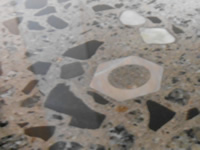
Nuts and Bolts Seeded into Concrete Floor
FULL EXPOSURE - CCC POLISHED CONCRETE